What Issue Revitalized Talmadge Supporters and Eugene Talmadge to Run Again for Governor in 1946
A controversial and colorful politician, Eugene Talmadge played a leading role in the state's politics from 1926 to 1946. During his three terms as state commissioner of agriculture and 3 terms as governor, his personality and actions polarized voters into Talmadge and anti-Talmadge factions in the land's i-political party politics of that era. He was elected to a quaternary term as the state's principal executive in 1946 but died before taking office.
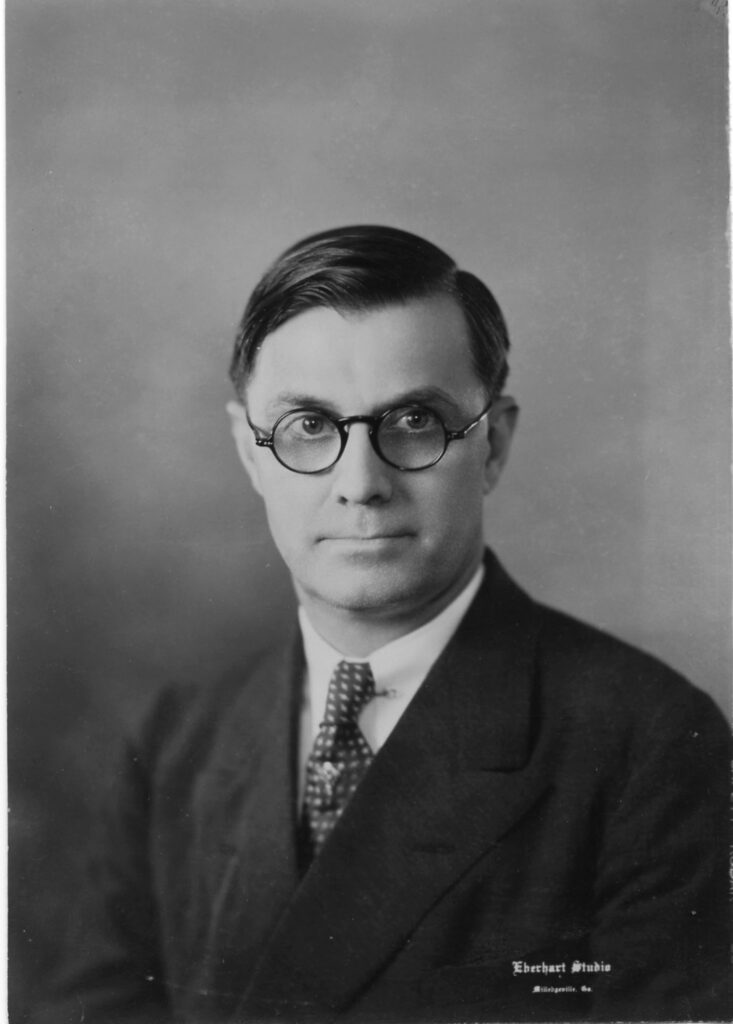
Family unit and Teaching
Eugene Talmadge was born on the family farm near Forsyth on September 23, 1884, to Carrie Roberts and Thomas R. Talmadge. After attention the University of Georgia and briefly teaching, Talmadge returned to Athens to earn a police force degree (1907). He practiced police force briefly in Atlanta before moving to Ailey and and then Mt. Vernon to first his own practice. In 1909 he married Mattie Thurmond Peterson, a young widow, who was the telegraph operator in Ailey. They had three children: Margaret, Vera, and Herman Eugene. The Talmadges later moved to a subcontract in Telfair County.
Early Political Career
After holding minor offices in Telfair Canton, Talmadge fabricated unsuccessful runs for state legislative part in 1920 and 1922. He finally won land constituent part by defeating Commissioner of Agriculture J. J. Brown in 1926. Talmadge was overwhelmingly reelected in 1928 and 1930. He used the department's newspaper, the Market Bulletin, to give advice to farmers on how to ameliorate their farming skills and operations. Just more of import, Talmadge used the Bulletin to express his views on political issues and to present himself as an outspoken advocate for the farmers. He extolled the virtues of a laissez-faire economical policy and private action to improve the well-being of farmers.
His critics in the legislature attempted to rein in the freewheeling and outspoken Talmadge. The senate adopted a commission report charging the commissioner with violating a state police force requiring that fertilizer fees collected by the department be deposited in the state treasury. The committee besides concluded that Talmadge had improperly spent section funds on a scheme to heighten the price of hogs. The senate committee further criticized the commissioner for having paid himself and family members more than $twoscore,000 in salaries and expenses and for using section funds to underwrite his annual trips to the Kentucky Derby. A committee of the Georgia house recommended that Governor Richard B. Russell Jr. sue Talmadge to recover state funds spent on the hog-ownership scheme. A minority report even chosen for his impeachment. The house agreed to sue but rejected the call to initiate impeachment proceedings against the commissioner. Russell referred the issue to the land attorney general, who declined to bring conform.
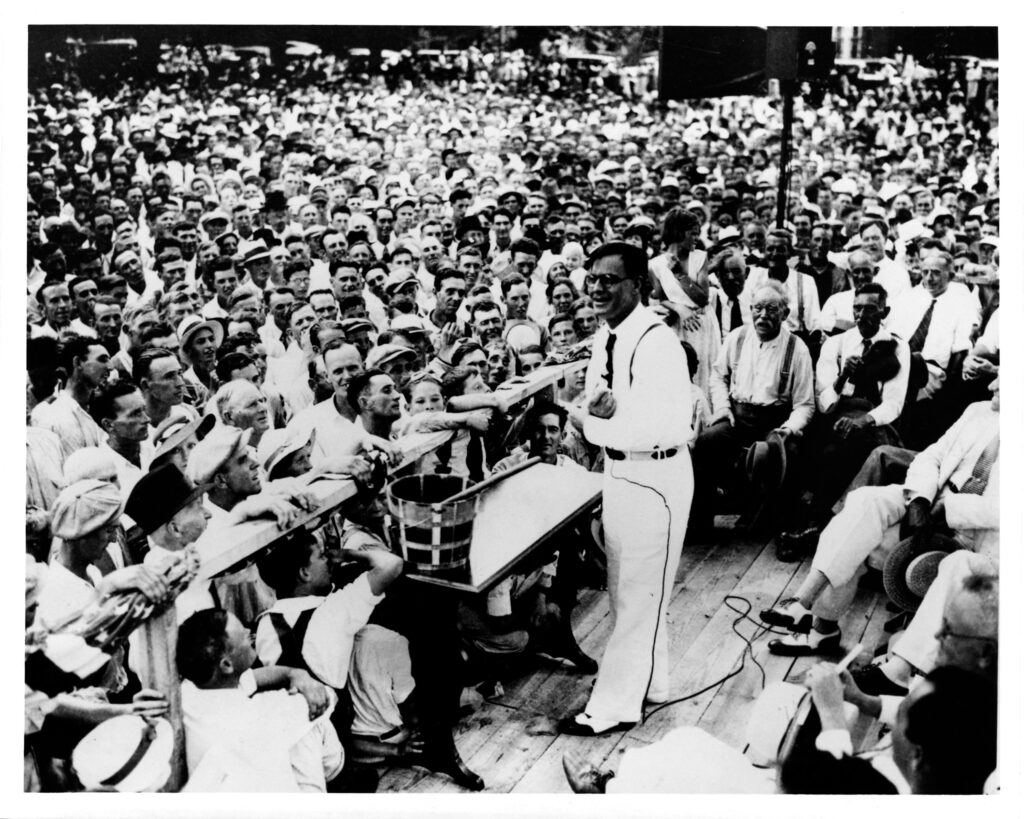
Governorship
Still popular with his rural constituency, Talmadge considered running for higher political part in 1932. Governor Russell ran for a seat in the U.Southward. Senate instead of seeking reelection. Talmadge entered the Democratic Party's crowded gubernatorial primary and won without a runoff. He promised to run the government economically, balance the state upkeep, lower utility rates, reduce the price of automobile tags to three dollars, and reorganize the state highway lath.
In the 1934 Autonomous gubernatorial primary, Talmadge easily won reelection, carrying every county but three. In his first 2 gubernatorial terms Talmadge proved to exist a strong governor. When the legislature refused to lower the cost of automobile tags, he did so by executive order. When the Public Service Commission, a body elected by the voters, refused to lower utility rates, he appointed a new board to get it washed. When the highway board resisted his efforts to control it, he alleged martial constabulary and appointed more cooperative members to the board. When the state treasurer and comptroller general refused to cooperate, the governor had them physically removed from their offices in the state capitol. Critics denounced him every bit a dictator, a demagogue, and a threat to the tranquillity of the state, but his supporters considered him a friend of the common homo and one of the state's outstanding governors.

Talmadge, a leading critic of the New Deal in the South, opposed the renomination of U.S. president Franklin D. Roosevelt in 1936. Barred by the state constitution from running again afterward two successive 2-year terms, Talmadge unsuccessfully ran for the U.S. Senate against the incumbent Richard Russell in 1936. Two years afterwards, his efforts to replace Senator Walter F. George likewise ended in failure. He finally returned to constituent office with his successful gubernatorial bid in 1940.
During his third term Governor Talmadge forced the Academy System Board of Regents to remove two faculty members, claiming that they were undermining the state's racial status quo, in what became known as the Cocking affair. In response to this political interference, the Southern Association of Colleges and Schools voted to withdraw accreditation from the state's white colleges. Promising to restore accreditation, state chaser full general Ellis Arnall ran confronting Talmadge in the 1942 gubernatorial primary and handed him the only loss Talmadge suffered in a gubernatorial contest.
Final Election
Although Arnall had a productive and progressive governorship, the state constitution, which had been inverse to lengthen the gubernatorial term from ii to 4 years, prohibited a successive term. Talmadge decided to run again. The federal courts' invalidation of the Autonomous Party's white main before the 1946 primaries gave Talmadge an of import issue. While Arnall supported the federal courts' decisions, Talmadge, denouncing the courts' deportment every bit a threat to segregation, promised to restore the white principal and to maintain the country's commitment to white supremacy. At that fourth dimension, statewide elections in Georgia were governed by a canton unit system of votes, which profoundly favored candidates whose back up came from rural counties. Under this system counties cast two, iv, or six votes, depending on their classification as rural, town, or urban areas, respectively. Although the anti-Talmadge candidate James V. Carmichael received the most popular votes in the primary, Talmadge, who had very stiff support in rural areas, won the gubernatorial nomination by obtaining a majority of the county unit of measurement votes.

Governor-elect Eugene Talmadge died on December 21, 1946, before taking office. His death resulted in i of the oddest political battles in Georgia's history, known as the "3 governors controversy." In Jan 1947 the General Assembly finally elected Eugene Talmadge'south son, Herman Talmadge, governor, although he had non run for office. He served until the state supreme courtroom overturned his legislative election in March.
Perhaps Herman Talmadge best described how Georgians felt about his begetter when he said that a third of the people would follow his father to hell and a 3rd of them wanted him in hell. Eugene Talmadge's belief in negative regime and his bitter opposition to the New Deal and racial equality did footling to improve the material well-existence of Georgians during his governorship.
Source: https://www.georgiaencyclopedia.org/articles/government-politics/eugene-talmadge-1884-1946/
0 Response to "What Issue Revitalized Talmadge Supporters and Eugene Talmadge to Run Again for Governor in 1946"
Post a Comment