New York Times January 24 1904 Pennsylvania Art Show
| Nellie Bly | |
|---|---|
 Elizabeth Cochran, "Nellie Bly," anile well-nigh 26 | |
| Born | Elizabeth Jane Cochran (1864-05-05)May five, 1864 Cochran's Mills, Armstrong Canton, Pennsylvania, U.Southward. |
| Died | January 27, 1922(1922-01-27) (aged 57) New York City, U.South. |
| Nationality | American |
| Other names | Elly Cochran, Elizabeth Jane Cochrane, and well-nigh commonly known as Nellie Bly every bit her pen-name |
| Occupation |
|
| Spouse(s) | Robert Seaman (m. 1895; died 1904) |
| Awards | National Women's Hall of Fame (1998) |
| Signature | |
 | |
| Notes | |
| Afterwards her marriage, Bly used the name "Elizabeth Cochrane Seaman." | |
Elizabeth Cochran Seaman (built-in Elizabeth Jane Cochran; May 5, 1864 – January 27, 1922), meliorate known past her pen proper name Nellie Bly, was an American journalist, industrialist, inventor, and clemency worker who was widely known for her tape-breaking trip effectually the earth in 72 days, in emulation of Jules Verne's fictional character Phileas Fogg, and an exposé in which she worked hole-and-corner to study on a mental establishment from within.[1] She was a pioneer in her field and launched a new kind of investigative journalism.[ii]
Early life [edit]
Elizabeth Jane Cochran was built-in May 5,1864,[3] in "Cochran's Mills", now part of the Pittsburgh suburb of Burrell Township, Armstrong County, Pennsylvania.[4] [5] [six] Her male parent, Michael Cochran, born about 1810, started out equally a laborer and mill worker before buying the local factory and most of the land surrounding his family farmhouse. He later became a merchant, postmaster, and associate justice at Cochran'due south Mills (which was named after him) in Pennsylvania. Michael married twice. He had 10 children with his kickoff wife, Catherine Murphy, and v more than children, including Elizabeth Cochran his thirteenth daughter, with his second wife, Mary Jane Kennedy.[7] Michael Cochran'south begetter had immigrated from County Londonderry, Ireland, in the 1790s. He died in 1871, when Elizabeth was half-dozen.[8]
As a young girl, Elizabeth often was chosen "Pinky" because she so ofttimes wore that color. As she became a teenager, she wanted to portray herself as more sophisticated and then dropped the nickname and changed her surname to "Cochrane".[9] In 1879, she enrolled at Indiana Normal Schoolhouse (now Indiana University of Pennsylvania) for one term but was forced to drib out due to lack of funds.[x] In 1880, Cochrane'southward mother moved her family to Allegheny Urban center, which was later annexed past the Urban center of Pittsburgh.[xi] A paper column entitled "What Girls Are Good For" in the Pittsburgh Dispatch that reported that girls were principally for birthing children and keeping business firm prompted Elizabeth to write a response under the pseudonym "Solitary Orphan Daughter".[12] [11] [xiii] The editor, George Madden, was impressed with her passion and ran an advertizement asking the author to identify herself. When Cochrane introduced herself to the editor, he offered her the opportunity to write a piece for the newspaper, again under the pseudonym "Lonely Orphan Girl".[13] Her starting time article for the Acceleration, entitled "The Daughter Puzzle", was about how divorce afflicted women. In it, she argued for reform of divorce laws.[14] Madden was impressed once more and offered her a total-time job.[11] Information technology was customary for women who were paper writers at that time to use pen names. The editor chose "Nellie Bly", later the African-American title character in the popular song "Nelly Bly" by Stephen Foster.[15] Cochrane originally intended that her pseudonym be "Nelly Bly", but her editor wrote "Nellie" by mistake, and the error stuck.[16]
Career [edit]

Portrait of a 21-twelvemonth-old Bly in Mexico
Pittsburgh Dispatch [edit]
Every bit a writer, Nellie Bly focused her early piece of work for the Pittsburgh Acceleration on the lives of working women, writing a series of investigative articles on women mill workers. However, the newspaper soon received complaints from factory owners about her writing, and she was reassigned to women'due south pages to comprehend way, club, and gardening, the usual role for women journalists, and she became dissatisfied. Still only 21, she was adamant "to practice something no girl has done before."[17] She then traveled to Mexico to serve as a foreign contributor, spending nearly half a year reporting on the lives and community of the Mexican people; her dispatches afterward were published in book course as Vi Months in Mexico. [xiv] In ane study, she protested the imprisonment of a local journalist for criticizing the Mexican government, so a dictatorship under Porfirio Díaz.[xviii] When Mexican authorities learned of Bly's written report, they threatened her with arrest, prompting her to flee the country. Safely domicile, she accused Díaz of being a tyrannical czar suppressing the Mexican people and decision-making the printing.[xi]
Asylum exposé [edit]

The New York City Mental Wellness Hospital on Blackwell'southward Island, c. 1893

Illustration of Bly being examined by a psychiatrist, from X Days in a Mad-Business firm
Burdened again with theater and arts reporting, Bly left the Pittsburgh Dispatch in 1887 for New York City. She faced rejection after rejection as news editors would not consider hiring a woman.[19] Penniless subsequently four months, she talked her way into the offices of Joseph Pulitzer'due south newspaper the New York Earth and took an secret assignment for which she agreed to feign insanity to investigate reports of brutality and neglect at the Women'south Lunatic Asylum on Blackwell's Island, now named Roosevelt Island.[20]
It was not an easy task for Bly to be admitted to the Aviary: she first decided to check herself into a boarding firm called Temporary Homes for Females. She stayed upwards all nighttime to requite herself the broad-eyed look of a disturbed woman and began making accusations that the other boarders were insane. Bly told the banana matron: "In that location are so many crazy people about, and one can never tell what they will do."[21] She refused to become to bed and eventually scared so many of the other boarders that the police force were called to take her to the nearby courthouse. Once examined by a police officer, a judge, and a doctor, Bly was taken to Blackwell'south Island.[21]
Committed to the aviary, Bly experienced the deplorable weather condition firsthand. After ten days, the aviary released Bly at The World 'south bidding. Her report, later published in volume form as Ten Days in a Mad-Firm, caused a sensation, prompted the aviary to implement reforms, and brought her lasting fame.[22] She had a significant impact on American culture and shed light on the experiences of marginalized women across the premises of the aviary as she ushered in the era of stunt girl journalism.[19]
In 1893, Bly used the celebrity status she had gained from her asylum reporting skills to schedule an exclusive interview with the allegedly insane serial killer Lizzie Halliday.[23]

United for Libraries Literary Landmark on Roosevelt Island that mentions Bly's connection to the island
Biographer Brooke Kroeger argues:
- Her two-part series in October 1887 was a sensation, effectively launching the decade of "stunt" or "detective" reporting, a articulate forerunner to investigative journalism and one of Joseph Pulitzer's innovations that helped give "New Journalism" of the 1880s and 1890s its moniker. The employment of "stunt girls" has often been dismissed as a circulation-boosting gimmick of the sensationalist press. Notwithstanding, the genre as well provided women with their first collective opportunity to demonstrate that, as a class, they had the skills necessary for the highest level of general reporting. The stunt girls, with Bly as their image, were the first women to enter the journalistic mainstream in the twentieth century.[24]
Around the world and general impact [edit]

In 1888, Bly suggested to her editor at the New York World that she take a trip around the globe, attempting to plow the fictional Effectually the World in Fourscore Days (1873) into fact for the first time. A twelvemonth later, at ix:xl a.m. on November 14, 1889, and with two days' detect,[25] she boarded the Augusta Victoria, a steamer of the Hamburg America Line,[26] and began her 40,070 kilometer journey. She took with her the dress she was wearing, a sturdy overcoat, several changes of underwear, and a small travel bag carrying her toiletry essentials. She carried about of her money (£200 in English bank notes and gilt, as well equally some American currency) in a pocketbook tied effectually her neck.[27] [28]
The New York paper Cosmopolitan sponsored its ain reporter, Elizabeth Bisland, to beat the fourth dimension of both Phileas Fogg and Bly. Bisland would travel the opposite style around the world, starting on the same 24-hour interval every bit Bly took off.[29] [30] Bly, however, did not learn of Bisland's journey until reaching Hong Kong. She dismissed the competition. "I would not race," she said. "If someone else wants to do the trip in less time, that is their concern."[17]
To sustain interest in the story, the Globe organized a "Nellie Bly Guessing Match" in which readers were asked to judge Bly's arrival time to the 2d, with the Grand Prize consisting at first of a trip to Europe and, later on, spending coin for the trip.[28] [31]

During her travels around the world, Bly went through England, French republic (where she met Jules Verne in Amiens), Brindisi, the Suez Canal, Colombo (Ceylon), the Straits Settlements of Penang and Singapore, Hong Kong, and Japan. The development of efficient submarine cable networks and the electric telegraph allowed Bly to send brusque progress reports,[32] although longer dispatches had to travel by regular post and thus were ofttimes delayed by several weeks.[31]
Bly traveled using steamships and the existing railroad systems,[33] which acquired occasional setbacks, particularly on the Asian leg of her race.[34] During these stops, she visited a leper colony in Prc[35] [36] and, in Singapore, she bought a monkey.[35] [37]
Equally a result of rough weather on her Pacific crossing, she arrived in San Francisco on the White Star Line ship RMSOceanic on January 21, 2 days behind schedule.[34] [38] However, afterward Globe owner Pulitzer chartered a individual railroad train to bring her home, she arrived back in New Jersey on January 25, 1890, at 3:51 pm.[32]
Just over seventy-two days afterward her departure from Hoboken, Bly was dorsum in New York. She had circumnavigated the globe, traveling alone for almost the entire journey.[26] Bisland was, at the time, still crossing the Atlantic, only to get in in New York 4 and a half days later. She as well had missed a connexion and had to board a ho-hum, old send (the Bothnia) in the place of a fast ship (Etruria).[25] Bly's journeying was a globe record, although it was bettered a few months later on by George Francis Train, whose get-go circumnavigation in 1870 possibly had been the inspiration for Verne's novel. Railroad train completed the journeying in 67 days, and on his third trip in 1892 in 60 days.[39] [twoscore] Past 1913, Andre Jaeger-Schmidt, Henry Frederick, and John Henry Mears had improved on the record, the latter completing the journey in fewer than 36 days.[41]
Novelist [edit]
After the fanfare of her trip around the world, Bly quit reporting and took a lucrative job writing serial novels for publisher Norman Munro's weekly New York Family Story Newspaper. The offset chapters of Eva The Adventuress, based on the real-life trial of Eva Hamilton, appeared in print earlier Bly returned to New York. Between 1889 and 1895 she wrote eleven novels. As few copies of the paper survived, these novels were thought lost until 2021, when writer David Blixt announced their discovery, found in Munro's British weekly The London Story Paper. [42] In 1893, though however writing novels, she returned to reporting for the World.
Later work [edit]
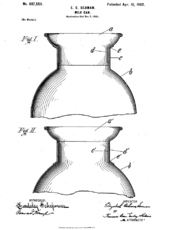
Patent for an improved Milk-Can

Bly speaking to a military machine officer in Poland
In 1895, Bly married millionaire manufacturer Robert Seaman.[43] Bly was 31 and Seaman was 73 when they married.[44] Due to her husband's failing health, she left journalism and succeeded her husband equally head of the Iron Clad Manufacturing Co., which made steel containers such as milk cans and boilers. In 1904, Seaman died.[45]
That same twelvemonth, Atomic number 26 Clad began manufacturing the steel barrel that was the model for the 55-gallon oil drum yet in widespread use in the United States. There have been claims that Bly invented the barrel[45] merely the inventor was registered as Henry Wehrhahn (U.Southward. Patents 808,327 and 808,413).[46]
Bly was, nevertheless, an inventor in her own correct, receiving U.Southward. Patent 697,553 for a novel milk tin and U.Southward. Patent 703,711 for a stacking garbage can, both under her married name of Elizabeth Cochrane Seaman. For a time she was 1 of the leading women industrialists in the United states. But her negligence, and embezzlement by a mill manager, resulted in the Atomic number 26 Clad Manufacturing Co. going bankrupt.[47]
Co-ordinate to biographer Brooke Kroeger:
She ran her company every bit a model of social welfare, replete with health benefits and recreational facilities. But Bly was hopeless at understanding the fiscal aspects of her business and ultimately lost everything. Unscrupulous employees bilked the firm of hundreds of thousands of dollars, troubles compounded past a protracted and costly defalcation litigation.[24]
Back in reporting, she wrote stories on Europe's Eastern Forepart during World State of war I.[48] Bly was the first adult female and one of the first foreigners to visit the war zone betwixt Serbia and Austria. She was arrested when she was mistaken for a British spy.[49]
Bly covered the Woman Suffrage Procession of 1913 for the New York Evening Journal. Her article's headline was "Suffragists Are Men's Superiors" and in its text she accurately predicted that it would exist 1920 earlier women in the U.s.a. would be given the right to vote.[l]
Death [edit]
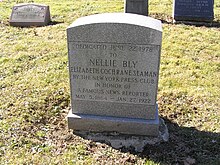
Bly's grave in Woodlawn Cemetery
On January 27, 1922, Bly died of pneumonia at St. Mark'due south Hospital, New York Metropolis, anile 57.[24] She was interred at Woodlawn Cemetery in The Bronx, New York City.[51]
Legacy [edit]
Honors [edit]
In 1998, Bly was inducted into the National Women'south Hall of Fame.[52] Bly was one of iv journalists honored with a The states postage postage stamp in a "Women in Journalism" set in 2002.[53] [54]
In 2019, the Roosevelt Island Operating Corporation put out an open phone call for artists to create a Nellie Bly Memorial art installation on Roosevelt Island.[55] The winning proposal, The Girl Puzzle past Amanda Matthews, was announced on October xvi, 2019.[56] The Daughter Puzzle opened to the public in December, 2021.[57]

Nellie Bly depicted as part of The Girl Puzzle Monument Honoring Nellie Bly, by creative person Amanda Matthews, located in Lighthouse Park on Roosevelt Island in New York City.
The New York Printing Club confers an almanac Nellie Bly Cub Reporter journalism award to admit the best journalistic effort by an individual with three years or less professional experience, in 2020 it was awarded to Claudia Irizarry Aponte, of THE CITY. [58]
Theater [edit]
Bly was the bailiwick of the 1946 Broadway musical Nellie Bly by Johnny Burke and Jimmy Van Heusen. The show ran for 16 performances.[59]
During the 1990s, playwright Lynn Schrichte wrote and toured Did You Prevarication, Nellie Bly?, a i-woman show about Bly.[60]
Moving picture and boob tube [edit]
Bly has been portrayed in the films The Adventures of Nellie Bly (1981),[61] ten Days in a Madhouse (2015),[62] and Escaping the Madhouse: The Nellie Bly Story (2019).[63] In 2019, the Center for Investigative Reporting released Nellie Bly Makes the News, a short animated biographical motion-picture show.[64] A fictionalized version of Bly every bit a mouse named Nellie Brie appears as a central character in the animated children'due south film An American Tail: The Mystery of the Night Monster.[65]
Anne Helm appeared equally Nellie Bly in the Nov 21, 1960, Tales of Wells Fargo Television episode "The Killing of Johnny Lash".[ commendation needed ] Julia Duffy appeared as Bly in the July 10, 1983 Voyagers! episode "Jack's Back".[ commendation needed ] The grapheme of Lana Winters (Sarah Paulson) in American Horror Story: Aviary is inspired by Bly's experience in the asylum.[66] Bly was besides a discipline of Flavor 2 Episode 5 of The Westward Wing in which Commencement Lady Abbey Bartlet dedicates a memorial in Pennsylvania in honor of Nellie Bly and convinces the President to mention her and other female historic figures on his weekly radio accost.[67]
Bly has been the field of study of two episodes of the Comedy Central serial Drunk History. The 2nd-season episode "New York City" featured her secret exploits in the Blackwell's Island asylum,[68] while the third-flavor episode "Journalism" retold the story of her race around the world confronting Elizabeth Bisland.[69]
On May 5, 2015, the Google search engine produced an interactive "Google Doodle" for Bly; for the "Google Doodle" Karen O wrote, composed, and recorded an original song most Bly, and Katy Wu created an animation set to Karen O'due south music.[70]
Literature [edit]
Bly has been featured equally the protagonist of novels by David Blixt,[71] Marshall Goldberg,[72] Dan Jorgensen,[73] Carol McCleary,[74] Pearry Reginald Teo and Christine Antipodal.[75] David Blixt also appeared on a March 10, 2021 episode of the podcast Broads You Should Know equally a Nellie Bly practiced.[76]
A fictionalized business relationship of Bly's effectually the earth trip was used in the 2010 comic book Julie Walker Is The Phantom published by Moonstone Books (Story: Elizabeth Massie, art: Paul Daly, colors: Stephen Downer).[77]
Bly is ane of 100 women featured in the first version of the volume Adept Nighttime Stories for Rebel Girls written past Elena Favilli & Francesca Cavallo.[78]
Eponyms and namesakes [edit]
The board game Round the World with Nellie Bly created in 1890 is named in recognition of her trip.[79]
The Nellie Bly Amusement Park in Brooklyn, New York Metropolis, was named subsequently her, taking as its theme Around the World in Lxxx Days. The park reopened in 2007[eighty] under new management, renamed "Adventurers Entertainment Park".[81]
A fireboat named Nellie Bly operated in Toronto, Canada, in the first decade of the 20th century.[82] From early in the twentieth century until 1961, the Pennsylvania Railroad operated an express train named the Nellie Bly on a route betwixt New York and Atlantic City, bypassing Philadelphia. In its early years, it was a parlor-car only railroad train; in 1901 information technology crashed, killing 17 people.[83]
-

A steam tug named later Bly served as a fireboat in Toronto, Ontario, Canada.[82]
-
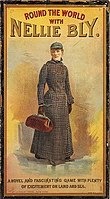
Cover of the 1890 lath game Round the World with Nellie Bly
Works [edit]
Within her lifetime, Nellie Bly published three not-fiction books (essentially compilations of her newspaper reportage) and 1 novel in volume form.
- Bly, Nellie (1887). X Days in a Mad-House. New York: Ian Fifty. Munro.
- Bly, Nellie (1888). Six Months in Mexico. New York: American Publishers Corporation.
- Bly, Nellie (1889). The Mystery of Cardinal Park. New York.
- Bly, Nellie (1890). Nellie Bly's Book: Around the Earth in Seventy-two Days. New York: The Pictorial Weeklies Company.
Betwixt 1889 and 1895 Nellie Bly also penned twelve novels for The New York Family Story Newspaper. Idea lost, these novels were not collected in book form until their re-discovery in 2021.[84]
- Eva The Adventuress (1889)
- New York By Night (1890)
- Alta Lynn, M.D. (1891)
- Wayne's Faithful Sweetheart (1891)
- Lilliputian Luckie, or Playing For Hearts (1892)
- Dolly The Coquette (1892)
- In Love With A Stranger, or Through Fire And Water To Win Him (1893)
- The Dear Of 3 Girls (1893)
- Niggling Penny, Child Of The Streets (1893)
- Pretty Merribelle (1894)
- Twins & Rivals (1895)
See also [edit]
- List of American print journalists
- Listing of female person explorers and travelers
- Nellie Bly Cub Reporter Award
- Women in journalism
References [edit]
- ^ Bernard, Diane (July 28, 2019). "She went cloak-and-dagger to expose an insane asylum'due south horrors. At present Nellie Bly is getting her due". The Washington Post.
{{cite news}}: CS1 maint: url-status (link) - ^ "American Experience". PBS. Archived from the original on March 5, 2017. Retrieved September 6, 2017.
- ^ Kroeger 1994, pp. iii & 5.
- ^ "Nellie Bly" (PDF). Pittsburgh Civic Light Opera. Archived (PDF) from the original on Nov 1, 2013. Retrieved July 20, 2013.
- ^ "Nellie Bly Historical Marker". Explore PA History. WITF-Television. Archived from the original on April fifteen, 2016. Retrieved July xx, 2013.
- ^ Cridlebaugh, Bruce S. "Cochran's Manufacturing plant Rd over Licks Run". Bridges and Tunnels of Allegheny County and Pittsburgh, PA. Archived from the original on August 28, 2017. Retrieved July xx, 2013.
- ^ Kroeger 1994, p. 3.
- ^ "Nellie Bly Biography". Biography.com. A&E Television Networks. Retrieved January 27, 2021.
{{cite web}}: CS1 maint: url-condition (link) - ^ Kroeger 1994, p. 25.
- ^ Englert, John; Houser, Regan (1994). "The New American Girl". IUP Mag. Indiana Academy of Pennsylvania. 12 (iv): 4–seven. Archived from the original on May one, 2010. Retrieved Apr 8, 2020.
- ^ a b c d Fritz, Arthur. "Nellie Bly, (1864–1922)". Nellie Bly Online. Archived from the original on March 23, 2016. Retrieved Apr 7, 2014.
- ^ "Young and Brave: Girls Changing History". National Woman's History Museum. Archived from the original on September vi, 2015. Retrieved April 7, 2014.
- ^ a b Jone Johnson Lewis. "Nellie Bly". Near.com. Archived from the original on February 11, 2017. Retrieved Apr 7, 2014.
- ^ a b Simkin, John (September 1997). "Nellie Bly". Spartacus Educational. Archived from the original on April 3, 2019. Retrieved Jan 24, 2018.
- ^ Adrian Room (2010). Lexicon of Pseudonyms: 13,000 Causeless Names and Their Origins, 5th ed. McFarland. p. 182. ISBN978-0-7864-5763-two.
- ^ Kroeger 1994, pp. 43–44.
- ^ a b "Nellie on the Fly". The Attic. Archived from the original on Apr 23, 2019. Retrieved February 1, 2019.
- ^ Bly, Nellie (1889). . . New York: American Publishers Corporation – via Wikisource.
- ^ a b Lutes, Jean Marie (2002). "Into the Madhouse with Nellie Bly: Girl Stunt Reporting in Late Nineteenth-Century America". American Quarterly. 54 (2): 217–253. doi:ten.1353/aq.2002.0017. ISSN 1080-6490. S2CID 143667078.
- ^ Gregory, Alice (May 14, 2014). "Nellie Bly's Lessons in Writing What You Desire To". The New Yorker. Archived from the original on July 19, 2019. Retrieved August 23, 2017.
- ^ a b Bly, Nellie (1887). Ten Days in a Mad-House. digital.library.upenn.edu. New York: Ian Fifty. Munro, Publisher. Archived from the original on Feb 16, 2004. Retrieved October xiii, 2018.
- ^ DeMain, Neb. "Ten Days in a Madhouse: The Adult female Who Got Herself Committed". mental floss. Archived from the original on May fourteen, 2019. Retrieved May 10, 2010.
- ^ Telfer, Tori (2017). Lady Killers: Mortiferous Women Throughout History. New York: HarperCollins Publishers. p. 69.
- ^ a b c Kroeger 2000.
- ^ a b Ruddick 1999, p. 4.
- ^ a b Kroeger 1994, p. 146.
- ^ Kroeger 1994, p. 141.
- ^ a b Ruddick 1999, p. v.
- ^ Barcousky, Len. "Eyewitness 1890: Pittsburgh welcomes home drifting Nellie Bly" Archived January 28, 2012, at the Wayback Machine, Pittsburgh Mail-Gazette, August 23, 2009. Retrieved Jan thirty, 2011
- ^ "Society Topics of the Week" Archived December 17, 2019, at the Wayback Motorcar. The New York Times, November 24, 1889. Retrieved January 30, 2011
- ^ a b Kroeger 1994, p. 150.
- ^ a b Ruddick 1999, p. 8.
- ^ Ruddick 1999, p. half-dozen.
- ^ a b Acquit, David. "Around the World With Nellie Bly." Pittsburgh Post-Gazette, November 26, 2006
- ^ a b Ruddick 1999, p. seven.
- ^ Kroeger 1994, p. 160.
- ^ Kroeger 1994, p. 158.
- ^ "Phineas Fogg Outdone". Daily Alta California. January 22, 1890. Archived from the original on July 20, 2011. Retrieved July twenty, 2013.
- ^ George Francis Train, The Bostonian Who Really Was Phileas Fogg Archived February 10, 2017, at the Wayback Car at the New England Historical Society
- ^ "William Lightfoot Visscher, Journal profile, part one". Skagitriverjournal.com. Archived from the original on October 26, 2016. Retrieved July 20, 2013.
- ^ The New York Times, "A Run Around the World", August viii, 1913
- ^ "Reid, Kerry "Nigh 100 Years After Her Death, Nellie Bly Is Back" Chicago Reader, Feb 2, 2021".
- ^ "Nellie Bly | American journalist". Encyclopedia Britannica. Archived from the original on August 23, 2017. Retrieved Baronial 23, 2017.
- ^ "Nellie Bly, journalist, Dies of Pneumonia". The New York Times. January 28, 1922. Archived from the original on November xv, 2011. Retrieved Nov 29, 2011.
- ^ a b "The Remarkable Nellie Bly". American Oil & Gas Historical Society. Archived from the original on Oct 4, 2011. Retrieved July twenty, 2013.
- ^ "Industries – Business History of Oil Drillers, Refiners". Concern History. Archived from the original on Oct half dozen, 2013. Retrieved July 20, 2013.
- ^ Garrison, Jayne. "Nellie Bly, Girl Reporter : Daredevil journalist". Los Angeles Times. Archived from the original on May 8, 2015. Retrieved May 5, 2015.
- ^ The remarkable Nellie Bly, inventor of the metal oil pulsate, Petroleum Age, 12/2006, p. 5.
- ^ Bly 1915.
- ^ Harvey, Sheridan (2001). "Marching for the Vote: Remembering the Woman Suffrage Parade of 1913". American Women. Library of Congress. Archived from the original on February 10, 2013. Retrieved March 3, 2013.
- ^ Dunning, Jennifer (Feb 23, 1979). "Woodlawn, Bronx'south Other Hall of Fame". The New York Times. Archived from the original on Jan x, 2018. Retrieved November 29, 2011.
- ^ "Elizabeth Jane Cochran – National Women's Hall of Fame". Greatwomen.org. Archived from the original on September 24, 2013. Retrieved July 20, 2013.
- ^ "Iv Accomplished Journalists Honored on U.Due south. Postage Stamps". about.com (Printing release). USPS. September fourteen, 2002. Archived from the original on October xvi, 2016.
- ^ Fletcher, Bertram Julian. "Nellie Bly Marguerite Higgins Ethel L. Payne Ida M. Tarbell March Women'southward History Month Lady Journalists on Postage Stamps". Archived from the original on February 9, 2018. Retrieved February 9, 2018.
- ^ "Nellie Bly Memorial Call for Artists". Roosevelt Island Operating Corporation of New York. New York State. Retrieved March two, 2021.
- ^ "Amanda Matthews of Prometheus Art Selected to Create Monument to Journalist Nelly Bly on Roosevelt Island, Press Release". Roosevelt Island Operating Corporation of New York. New York State. Retrieved March 2, 2021.
- ^ "Monument honoring journalist Nellie Bly opens: "This installation is spiritual"". CBS News. December xi, 2021. Retrieved March 24, 2022.
- ^ "New York Press Club Announces its 2020 Journalism Award Winners – The New York Printing Club". www.nypressclub.org . Retrieved November 5, 2021.
- ^ Dietz 2010, p. 310.
- ^ "Lynn Schrichte". Resourceful Women. Library of Congress. Archived from the original on January 25, 2018. Retrieved January 24, 2018.
- ^ The Adventures of Nellie Bly at AllMovie
- ^ "Fearless Feminist Reporter Nellie Bly Hits the Big Screen". Ms. Magazine . Retrieved July 20, 2020.
- ^ Bentley, Rick. "Judith Light hopes 'The Nellie Bly Story' will prompt mental wellness discussions". Chicago Tribune . Retrieved July xx, 2020.
- ^ Reveal 2017.
- ^ "Nellie Bly". Popular Pittsburgh. February eleven, 2015. Retrieved July twenty, 2020.
- ^ Eidell, Lynsey (October 7, 2015). "All the Existent-Life Scary Stories Told on American Horror Story". Glamour. Archived from the original on June xix, 2018. Retrieved Jan 24, 2018.
- ^ MacIntosh, Selena (July 2011). "Ladyghosts: The West Wing 2.05, 'And It's Surely to Their Credit'". Persephone. Archived from the original on Feb 5, 2012. Retrieved January 24, 2018.
- ^ "Nellie Bly Goes Hush-hush at Blackwell's Isle". cc.com. One-act Central. July viii, 2014. Archived from the original on January 25, 2018. Retrieved January 24, 2018.
- ^ "Journalism". cc.com. Comedy Central. Oct twenty, 2015. Archived from the original on Jan 25, 2018. Retrieved January 24, 2018.
- ^ "What Girls are Skilful For: Happy birthday Nellie Bly". May iv, 2015. Archived from the original on May vii, 2015. Retrieved May 5, 2015.
- ^ "What Girls Are Good For - A Novel Of Nellie Bly". Side by side Chapter . Retrieved April 28, 2021.
- ^ "The New Colossus". diversionbooks.com/ebooks/new-colossus. Archived from the original on April 24, 2014. Retrieved April 29, 2014.
- ^ Callison, Jill (March 23, 2015). "Writer: At that place's gold in them thar southern Black Hills". U.s. Today. Archived from the original on January 25, 2018. Retrieved January 24, 2018.
- ^ "Books". Carol McCleary. Archived from the original on May xiv, 2016. Retrieved January 24, 2018.
- ^ "Bedlam Stories". Archived from the original on October one, 2013. Retrieved September 24, 2013.
- ^ Broads Yous Should Know (2021). "Nellie Bly".
- ^ "024. Julie Walker: The Phantom (A)". Moonstonebooks.com. Archived from the original on July 29, 2013. Retrieved July 20, 2013.
- ^ Establishment, The (May 22, 2016). "New Book Gives Rebel Girls The Bedtime Tales They Deserve". The Institution . Retrieved Nov 5, 2021.
- ^ "Round the earth with Nellie Bly—The Worlds globe circler". Library of Congress. 1890. Archived from the original on January 25, 2018. Retrieved January 24, 2018.
- ^ ""Adventurer'due south Entertainment Park"". UltimaterollerCoaster.com. Archived from the original on July 28, 2015. Retrieved May five, 2015.
- ^ "Charlatan's Park Family Entertainment Eye – Brooklyn, NY". adventurerspark.com. Archived from the original on May three, 2015. Retrieved May 5, 2015.
- ^ a b Chris Bateman (2013). "The nautical adventures of the Trillium ferry in Toronto". Blog TO. Archived from the original on August 28, 2018. Retrieved August 11, 2018.
A 2nd fire boat, the Nellie Bly, presumably named subsequently the American announcer famous for her round-the-world trip and exposé slice of US mental health practices, was also involved. 'Their combined efforts prevented the fire from spreading,' noted the Star.
- ^ ""Terrible Wreck On Pennsylvania Road" The Gloversville Daily Leader Feb 22, 1901" (PDF). Archived (PDF) from the original on February five, 2020. Retrieved May v, 2015.
- ^ "Pulp | Arts Around Ann Arbor".
Further reading [edit]
- Bly, Nellie (January 12, 1915). "American Woman Imprisoned in Austria; Liberated When Identified past Dr. Friedman". Los Angeles Herald. p. 2. Retrieved May 13, 2020.
- Dietz, Dan (2010). Off Broadway Musicals, 1910–2007: Casts, Credits, Songs, Critical Reception and Performance Information of More Than 1,800 Shows. McFarland. ISBN978-0786457311.
- Goodman, Matthew (2013). 80 Days: Nellie Bly and Elizabeth Bisland's History-Making Race Around the World. ISBN9780345527264.
- Kroeger, Brooke (1994). Nellie Bly: Daredevil, Reporter, Feminist. Three Rivers Press. ISBN978-0812925258.
- Kroeger, Brooke (February 2000). "Bly, Nellie". American National Biography. doi:x.1093/anb/9780198606697.article.1601472.
- Lutes, Jean Marie (June 2002). "Into the Madhouse with Nellie Bly: Girl Stunt Reporting in Late Nineteenth-Century America". American Quarterly. Johns Hopkins University Printing. 54 (ii): 217–253. doi:10.1353/aq.2002.0017. S2CID 143667078 – via Project MUSE.
- Mahoney, Ellen (Summer 2017). "Nellie Bly: Pioneer announcer extraordinaire". Western Pennsylvania History: 32–45.
- "Nellie Bly Makes the News". Reveal. The Center for Investigative Reporting. 2017. Retrieved May eleven, 2020.
- Parham, Stacey Gaines (2010). Nellie Bly, "the best reporter in America": one adult female'southward rhetorical legacy (PDF) (PhD thesis). The University of Alabama.
- Randall, David (2005). "Nellie Bly: The best undercover reporter in history". The Great Reporters. London: Pluto Press. pp. 93–113. ISBN0745322972.
- Rittenhouse, Mignon (1956). The Astonishing Nellie Bly. Dutton.
- Roggenkamp, Karen (2016). Sympathy, Madness, and Crime: How 4 Nineteenth-century Journalists Fabricated the Newspaper Women's Concern. Kent Country University Printing. ISBN978-1606352878.
- Ruddick, Nicholas (1999). "Nellie Bly, Jules Verne, and the World on the Threshold of the American Age". Canadian Review of American Studies. 29 (1): 1–12. doi:ten.3138/CRAS-029-01-01. S2CID 159883003.
- Vengadasalam, Puja (September ten, 2018). "Dislocating the Masculine: How Nellie Bly Feminised Her Reports". Social Change. 48 (3): 451–458. doi:10.1177/0049085718781597. S2CID 149576773.
External links [edit]
- Information, photos and original Nellie Bly articles at Nellie Bly Online
- Library of Congress "Nellie Bly: A Resource Guide"
- Nellie Bly'due south collected journalism at The Archive of American Journalism
- Norwood, Arlisha. "Nellie Bly". National Women's History Museum. 2017.
- The Daring Nellie Bly: America's Star Reporter illustrated biography by Bonnie Christensen, reviewed by Maria Popova
- Works past Nellie Bly at Project Gutenberg
- Works by or about Nellie Bly at Internet Archive
- Works by Nellie Bly at LibriVox (public domain audiobooks)

Source: https://en.wikipedia.org/wiki/Nellie_Bly
0 Response to "New York Times January 24 1904 Pennsylvania Art Show"
Post a Comment